Dream Killers, Status Quo, The Resistance and The Lizard Brain
Aug 04, 2023
Progress is rarely blocked by complexity alone — it is stalled by fear, doubt, and allegiance to the status quo. Leaders must recognize both the external dream killers and the internal resistance that whisper “stay safe.” Courage begins when we choose the work over the fear.
What stops progress?
What hinders those who are on the path to lead, to grow, and to make real progress?
Dream Killers and Lovers of Status Quo. These are the outward and external sources.
They could be anybody, those you work with, family, friends, and online followers or commenters.
They speak the language of doubt, disapproval, despair, and discord.
They are crabs in a bucket all clawing to pull you down. When its passive its non-answers, slights of hand, or seeds of doubt. At times it’s somewhere in between with non-compliance, maliciousness, and direct confrontation. Sometimes its not about you at all, its about them.
Any of these sound familiar?
-
It’s too soon for that
-
It’s to hard
-
We’ve done that before, it didn’t work
-
That’s not how we do things here
-
That may work for (some company) but won’t work here
-
It’s been done before
-
It’s never been done before
-
It’s too risky
-
It’s too fuzzy
-
Our boss, manager, board won’t approve
-
Our roadmap is full already
-
We have too much tech debt
-
Sales or Engineering or Ops, or some department won’t do that
-
That’s not someone's job
-
That’s not in the budget
And surprisingly, or shockingly, when we look in the mirror we may even find that the dream killer and lover of status quo is us, our own inner voice and critic.
But THAT is not the same thing.
When it’s in you…. It’s The Resistance, It’s the Lizard Brain.
Steven Pressfield is a famous author and screenplay writer.
In his book, The War of Art: Break through the blocks and win your inner battle, he coins a term for the mysterious force that seeks to limit us from our best selves. He calls it The Resistance.
“Resistance will tell you anything to keep you from doing your work. … If you take Resistance at its word, you deserve everything you get. Resistance is always lying and always full of shit.” — Steven Pressfield
In under 200 pages, the War of Art is a fast and enjoyable read that gives The Resistance shape by viewing it from all sides, top to bottom and bottom to top.
The Resistance works at you in these ways:
-
Procrastination - Putting off working on your creative projects or important goals. Pressfield calls procrastination "the most common manifestation of Resistance."
-
Self-doubt - Questioning your talents, skills, and whether you have what it takes to succeed. Self-doubt can lead to immobilization.
-
Fear - Being afraid to take risks, put yourself out there, or pursue your dreams. Fear of failure, fear of rejection, fear of the unknown.
-
Perfectionism - Spending more time polishing or tweaking than producing new work. The endless pursuit of perfection paralyzes production.
-
Rationalization - Making elaborate excuses for why you can't do your work. Blaming external factors rather than taking responsibility.
-
Victim mentality - Making yourself out to be powerless, at the mercy of outside forces. Feeling like the world is against you.
-
Distractions - Willingly distracting yourself as a form of procrastination. Busyness, internet surfing, obsessions.
-
Addiction - Compulsive behaviors and substance abuse issues that prevent you from doing your work.
-
Laziness - Lack of self-discipline, difficulty waking up and getting started, wasting time and waiting for inspiration.
-
Self-sabotage - unconsciously undermining your own efforts, often due to fear of success.
It’s a sobering list. And it’s good to see it on the page and give it a name. The Resistance.
In the book Linchpin: Are you indespensible, author Seth Godin, brings this thinking a step further. He makes it a matter of biology. While Pressfield is creative and known for his story telling and writing of fiction and non-fiction and great movies, Godin, on the other hand, is an entrepreneur, mensch, and business author with more than a dozen best-selling business books. He writes too and for a business audience. People like you and me.
He cites Pressfield’s The Resistance, and says it’s not a mysterious force. It’s our primal lower brain, the instinctive part of the brain responsible for basic survival and fear responses. It’s the Lizard Brain.
Seth makes a great case in the book on how the Lizard Brain is blocking our progress. It’s the Lizard Brain that holds us back from taking risks or pursuing our goals.
“The lizard brain is hungry, scared, angry, and horny.The lizard brain only wants to eat and be safe.
The lizard brain will fight (to the death) if it has to, but would rather run away. It likes a vendetta and has no trouble getting angry.
The lizard brain cares what everyone else thinks, because status in the tribe is essential to its survival.
A squirrel runs around looking for nuts, hiding from foxes, listening for predators, and watching for other squirrels. The squirrel does this because that's all it can do. All the squirrel has is a lizard brain.
The only correct answer to 'Why did the chicken cross the road?' is 'Because it's lizard brain told it to.' Wild animals are wild because the only brain they posses is a lizard brain.
The lizard brain is not merely a concept. It's real, and it's living on the top of your spine, fighting for your survival. But, of course, survival and success are not the same thing.
The lizard brain is the reason you're afraid, the reason you don't do all the art you can, the reason you don't ship when you can. The lizard brain is the source of the resistance.” — Seth Godin
This happens because it’s natural to want to be safe and to protect our status. It’s natural to get angry, emotional, fearful and feel like you need to fight or flee.
But walking the path of a leader means seeing these, by and large, are all false reasons to hold back on our work. There is no progress on The Path of a Leader when fear or anger take the wheel. The call is to move forward with courage, clarity, and commitment to doing the work that matters.
Fear is a liar. Anger is a thief.
Today, most things that prompt fear - especially in the modern workplace - is a signal that most likely doesn’t mean fear at all, instead it means we just might be moving into a situation where healthy conflict and tension are providing fertile ground for progress to be made, a transformation to occur, a status quo to change. It is likely signaling an opportunity to step forward in doing the hard and meaningful work we were meant to do.
Write this on a sticky note and place it by your monitor.
I will not surrender what I’m here to do at the insistence of the Dream Killers, the Status Quo, The Resistance or The Lizard Brain.
I believe in you. You got this!
For those ready to move forward and lead at new levels, I recommend you adopt the 4 Cornerstones (below) so you can best activate your high-performing team as you help them rise above the lizard brain, resistance, status quo and dream killers.
The 4 Cornerstones of a GSD Guide
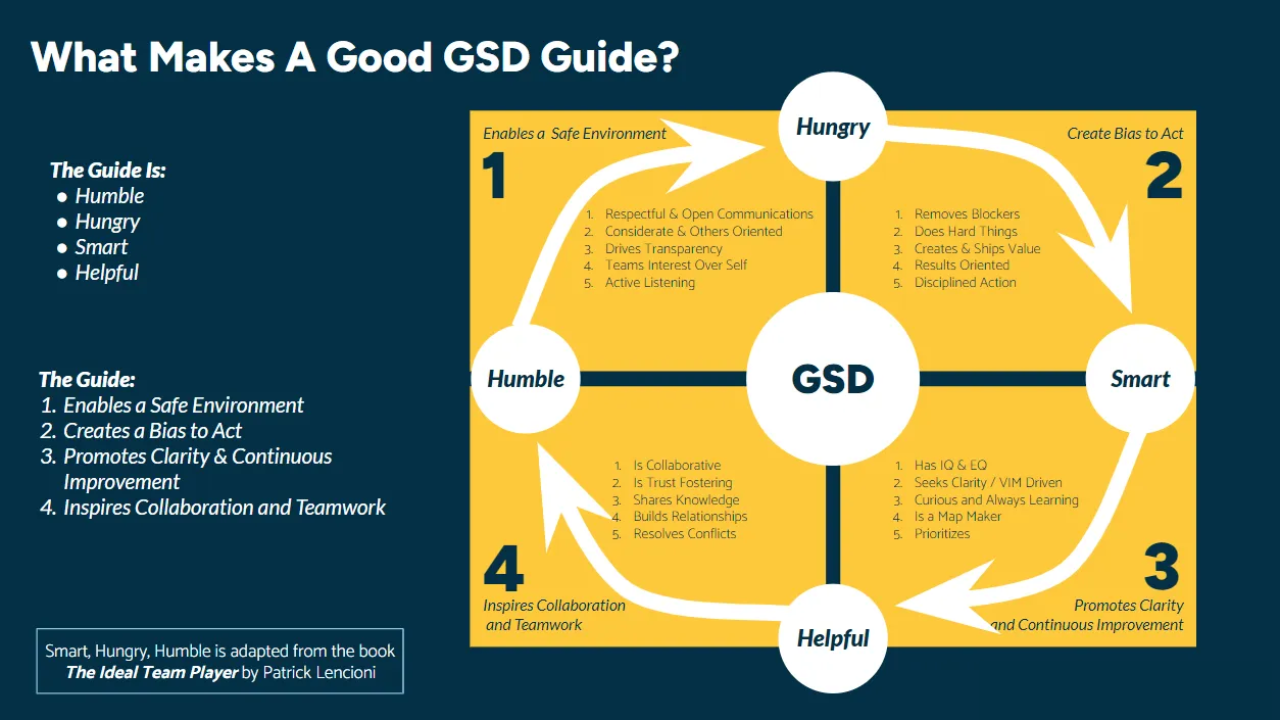
As we work to get the right stuff done—faster and with larger teams—we must create the conditions for change, transformation, and doing our best work. This is a crucial part of leading well. It’s inspired by Patrick Lencioni’s best-selling book The Ideal Team Player and shaped by our own tested practices in The Path of a Leader.
#ThePathOfALeader
#GSD
Appreciate you,
Justin
This post is part of The Path of a Leader — a collection of 36 powerful lessons on growth, leadership, and getting the right stuff done.
→ View the Full Series Index